
What are DevOps managed services?
Strip the marketing off and DevOps managed services are simple: you keep writing the application, and a provider takes ongoing responsibility for everything between a git push and a customer using the feature. Build and deploy pipelines, the cloud accounts, Kubernetes or whatever runs the containers, monitoring, backups, patching, and the 3am page when something falls over.
You'll see the same thing sold as managed DevOps services, DevOps as a service, DevOps as a managed service or cloud DevOps management services, depending on who wrote the brochure. The label doesn't matter much. What matters is the shape of the agreement: which hours are covered, who's responsible for what, and who you ring when it goes wrong.
What managed DevOps services include
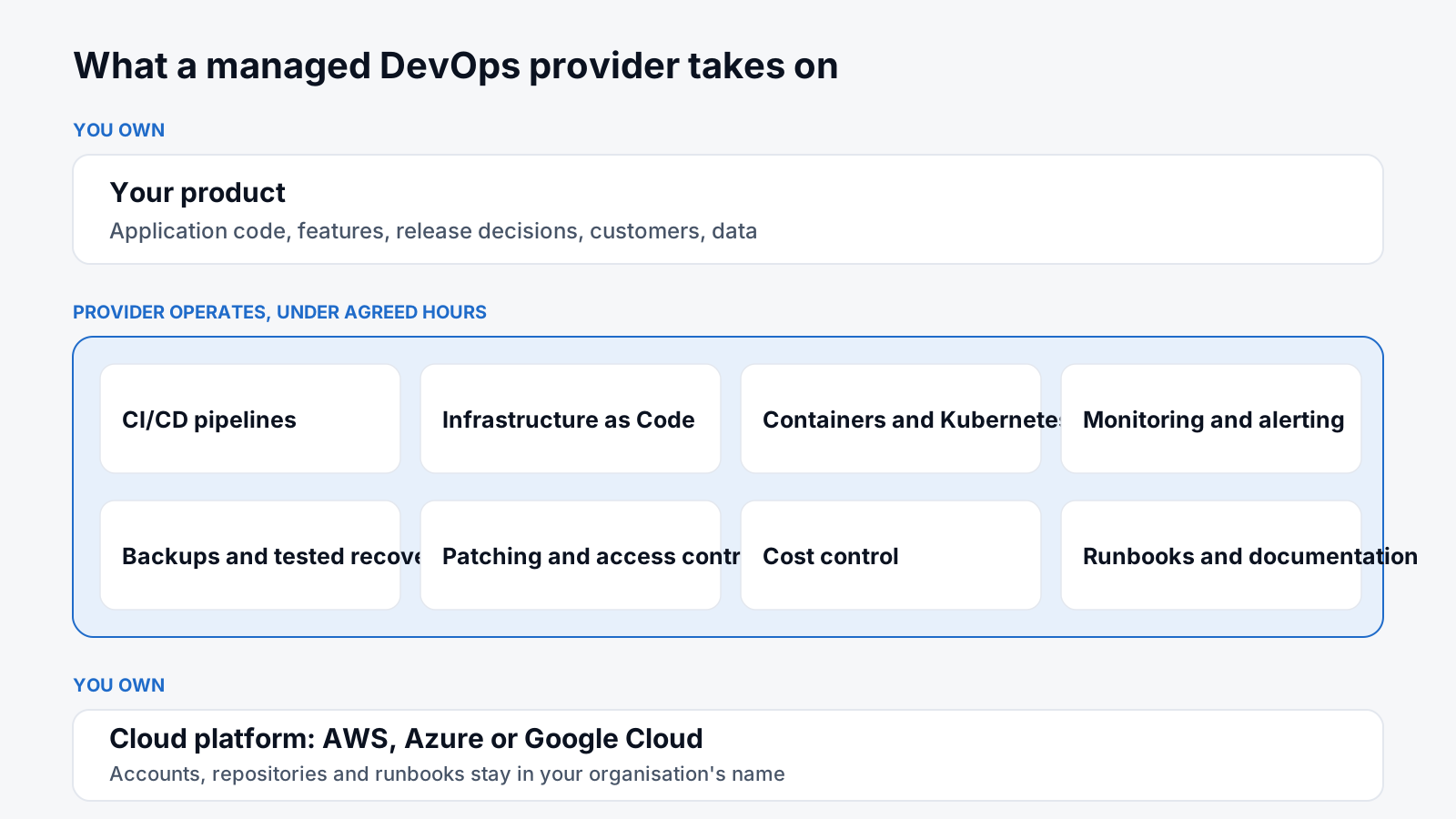
Scope is agreed per team, but if a DevOps managed service provider doesn't cover most of this list, ask why.
- CI/CD pipelines. Build, test, deploy, roll back. Repeatable, in version control, and not dependent on one person's laptop.
- Infrastructure as Code. Terraform or OpenTofu, CloudFormation, Bicep, Pulumi; the tool matters less than the fact that the infrastructure lives in a repo you can read and diff.
- Cloud accounts and environments. Account structure, networking, IAM, separate dev, staging and production, and migrations when you outgrow the current setup.
- Containers and Kubernetes. Images, cluster upgrades (which arrive more often than anyone likes), node sizing, ingress, secrets.
- Linux. Still underneath most of it. Patching, hardening, the odd disk that fills up at the worst moment.
- Monitoring, logging, alerting. Finding out about problems from a dashboard rather than from a customer, and having a named person who responds.
- Backups and recovery. Not just "backups are on". A restore that has actually been tested, with a written procedure.
- Security hygiene. Access reviews, secrets management, patch cadence. The things a SOC 2 auditor will ask about later.
- Cost control. Right sizes, schedules for non-production, commitments reviewed. There's a separate guide on cloud cost optimisation and cutting an AWS bill.
- Runbooks and documentation. Kept with the code, updated when the setup changes, written so your own engineers could follow them at 2am.
Managed DevOps vs managed cloud services vs DevOps consulting
These three get used interchangeably and they shouldn't be.
Managed cloud services usually stop at the infrastructure: servers, networks, backups, patching, the cloud bill. Somebody keeps the lights on. What they generally don't touch is how your code gets to production.
DevOps consulting services are project work. A consultancy designs and builds the pipeline or the platform, hands over a wiki page and leaves. Great for a migration or a one-off rebuild; less great a month later, when something breaks and nobody owns the alerts.
Managed DevOps services cover the infrastructure and the delivery path, and they stay. The provider operates what it built and is on the hook when it breaks. Plenty of engagements start as consulting and turn into managed DevOps once the team realises the work never really ends.
DevOps outsourcing vs hiring a DevOps engineer
The other comparison people make is outsourcing against a first DevOps hire. Here's how they differ in practice.
| DevOps managed services | Hiring a DevOps engineer | DevOps consulting project | |
|---|---|---|---|
| Who runs production | The provider, within agreed hours | Your new hire | Your team, after handover |
| Skills on tap | A team: cloud, CI/CD, Kubernetes, security | One person's background | Specialists, for the project only |
| Holiday and leaver cover | Built in | None, it's one person | Not applicable |
| Time to start | After an assessment | Recruiting plus onboarding | After discovery |
| How you pay | Monthly, priced to scope and coverage | Salary and tooling, whatever the workload | One-off |
| Makes sense when | You ship regularly and have no platform team | Infrastructure is your core product | You need one specific build or migration |
A single DevOps hire is a perfectly good option, as long as you're comfortable that your release process depends on one person's availability. Many small teams aren't, once they've thought about it. When you do compare DevOps outsourcing services, compare like for like: hours covered, who's on call and what's written down, not the hourly rate.
Where managed Kubernetes services fit
"Managed Kubernetes" means two different things. EKS, AKS and GKE are managed Kubernetes from the cloud provider: they run the control plane, and you still own the nodes, upgrades, add-ons, networking, autoscaling and everything you deploy. Managed Kubernetes services from a DevOps provider pick up that remaining part, which is the part that actually takes the time. If you're running EKS and nobody has done a version upgrade in a year, that's the gap.
DevOps on AWS, Azure and Google Cloud
The principles don't change between clouds; the tooling does. AWS DevOps services usually means CodePipeline or GitHub Actions deploying to ECS, EKS or Lambda, with Terraform or CloudFormation underneath and IAM doing a lot of heavy lifting. Azure DevOps managed services tend to revolve around Azure Pipelines or GitHub Actions, Bicep or Terraform, AKS and Entra ID. On Google Cloud it's Cloud Build, GKE or Cloud Run and Terraform. Ask a provider which of these they've run in production, not which logos are on their website. IAM, networking and Kubernetes differ enough between the three that experience doesn't fully transfer.
When DevOps managed services make sense
The clearest signal is a bus factor of one. Deployments wait for a particular engineer. Production was set up by hand a few years ago and nobody is entirely sure how to rebuild it. If that sounds familiar, the risk already exists; a managed service just makes someone responsible for it.
Some other patterns we see in teams who come to us:
- Developers lose their afternoons to infrastructure instead of the product.
- Customers notice outages before the monitoring does.
- Staging doesn't match production and nobody can list the differences.
- The cloud bill has grown faster than the customer base and nobody can explain the gap.
- An enterprise prospect has sent a security questionnaire asking about backups, access control and SOC 2.
- An agency hosts client applications and every project has its own hand-rolled deployment.
Two or three of those together is usually enough.
DevOps services for startups
Startups are a special case. Early on, you need production to be boring, releases to be safe and the cloud bill to be explainable when an investor asks, but a full-time platform engineer is hard to justify before product-market fit. A small managed DevOps engagement gets the foundations right (Infrastructure as Code, a proper pipeline, monitoring, backups, sane IAM) at a fraction of a hire, and leaves you with something a future in-house engineer can pick up without rewriting.
When they don't
Managed DevOps isn't the answer for everyone, and a provider who says it is should worry you.
If infrastructure is your product, build that capability in-house and bring in outside help for specific projects. If you already have a working platform team, a managed service duplicates them. And if you run one small app for a handful of users with no release pressure, a managed hosting platform plus decent backups is probably enough for now. A good provider will tell you that during the assessment instead of selling you coverage you don't need.
How an engagement actually runs
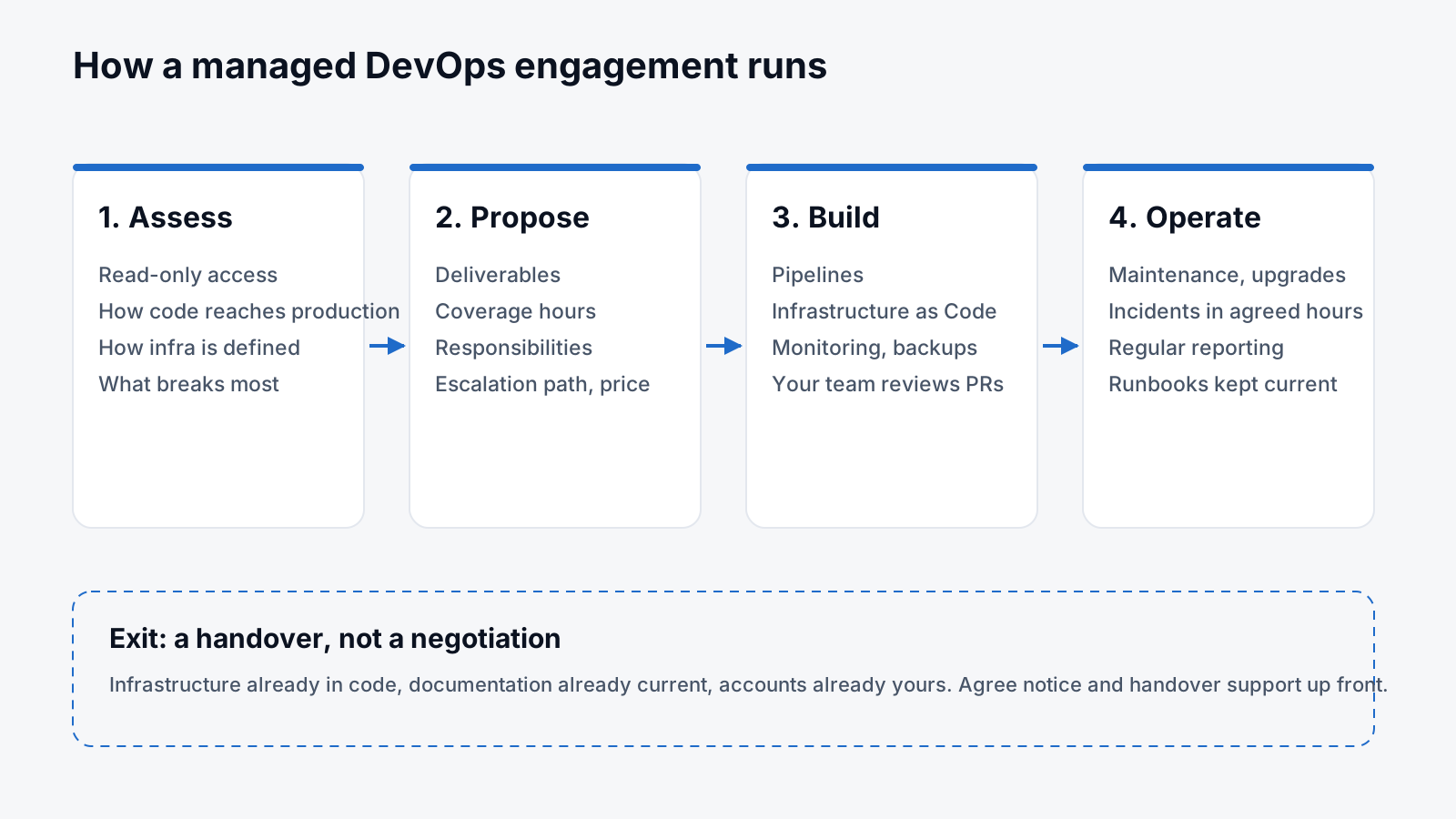
- Assessment. The provider gets read-only access and looks at how code gets to production, how infrastructure is defined, how you find out about problems and what breaks most. You tell them where it hurts.
- Proposal. Deliverables, coverage hours, who does what, escalation path, price. In writing. Cloud spend and third-party tools listed separately so you can see them.
- Build. Pipelines, Infrastructure as Code, monitoring, backups: brought up to standard in stages, with your engineers reviewing the pull requests.
- Operate. The ongoing part: maintenance, upgrades, incidents inside the agreed hours, a regular report, and runbooks kept current as things change.
Exit should be boring. If the infrastructure is in code, the docs are current and the accounts are yours, leaving is a handover rather than a negotiation. Ask about the exit before you sign; it tells you a lot about how the provider works.
DevOps as a service pricing: what drives the cost
Two shapes, mostly. A defined project with a fixed scope and price (build the pipeline, do the migration), or a monthly arrangement priced to coverage. What moves the monthly figure:
- how many environments you run and how different they are from each other,
- the coverage hours, business hours only or out of hours as well,
- how much change you push (a team deploying daily needs more hands than one deploying monthly),
- whether Kubernetes, compliance work or more than one cloud is involved.
Cloud and tooling costs stay in your accounts and on your invoices. Be wary of anyone who bundles cloud spend into one opaque fee; you lose the ability to see what's being spent on what, which is exactly the visibility a managed service is supposed to give you.
We publish ours: the pricing page lists each managed DevOps plan with its hours, response times and what is excluded, so you can compare it with a hire or another provider before talking to anyone.
How to choose a DevOps managed service provider
A checklist we'd use ourselves if we were the ones buying. It applies whether you're looking at DevOps outsourcing companies, a local consultancy or a freelancer.
- They look before they quote. A proposal that turns up before anyone has seen your stack is a guess with a price on it.
- You own everything. Cloud accounts, Terraform repos, pipeline definitions, runbooks, all in your organisation's name. If the provider's accounts are in the critical path, that's lock-in with extra steps.
- Coverage is defined. Hours, response expectations, who's on call, how to escalate. "24/7" on a website means nothing until it's in the contract with a definition.
- They've run production on your cloud. See above. Ask for specifics.
- Security is part of the service, not an add-on. Ask how they handle access, secrets and patching, and whether their work would survive a SOC 2 readiness review.
- They measure. Deployment frequency, failed changes, time to restore, cloud cost against a baseline. Reported, not claimed.
- They're the right size for you. A provider built around enterprise accounts will under-serve a ten-person SaaS team, and the reverse is also true.
- Price follows scope. Fixed packages that ignore how many environments you have, or whether you run Kubernetes, are usually priced for someone else.
Questions worth asking before you sign
- Who's accountable when a deploy fails at 17:55 on a Friday, and how do we reach them?
- What documentation do we get, and who keeps it current?
- How do changes to production get reviewed and approved?
- When was the restore procedure last tested, and by whom?
- Which parts of the service are automated and which rely on someone remembering?
- What does leaving look like if we build an in-house team later?
- How will you show us the service is working?
Providers who've done this before answer these quickly and specifically. Hesitation is data.
How we do it at Autostat
Our managed DevOps and cloud service covers the list above: CI/CD, Infrastructure as Code, Docker and Kubernetes operations, Linux, cloud migration, monitoring, backups and recovery planning, on AWS, Azure and Google Cloud. We assess first, with a fixed-price DevOps assessment, then offer either a defined project or a monthly plan with published hours and response times, and we leave runbooks your team can actually use. SaaS teams that also need cost control and SOC 2 readiness usually take the Secure SaaS Growth Bundle, which puts that work in one plan.